

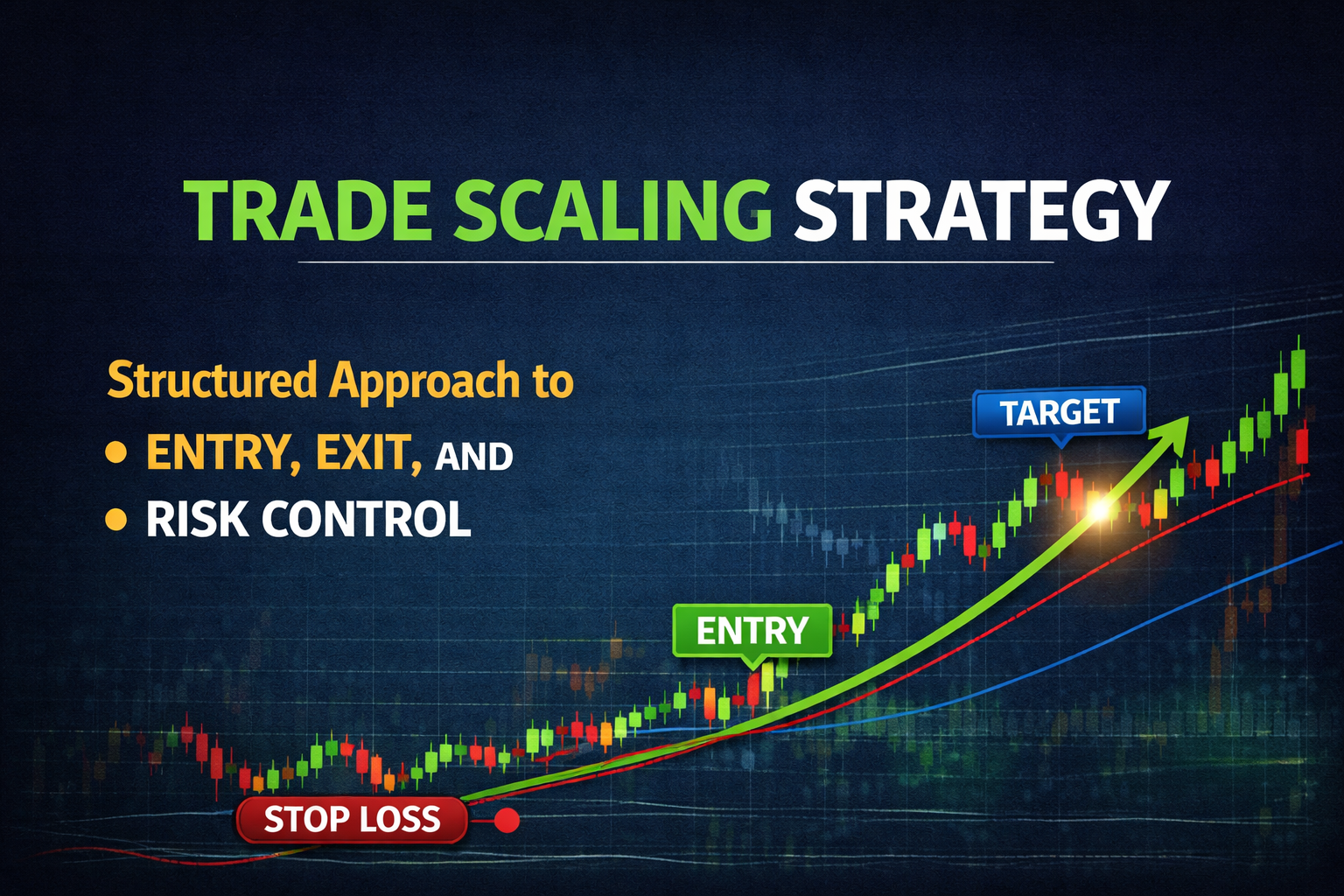
What is Scaling?
Scaling in trading means dividing a trade into smaller parts instead of entering or exiting all at once. A trader takes positions at different price levels to manage the trade better and handle market uncertainty.
There are two main types of scaling.
- Scaling in is when a trader adds positions step by step, either when the price reaches important levels like support or when the trend moves in their favor, so the overall entry price becomes better.
- Scaling out is when a trader closes parts of the trade at different profit levels instead of closing everything at once, which helps secure profits while still keeping some position open to catch bigger moves. This approach helps control risk, improves trade execution, and reduces emotional pressure.
Why Traders Use Scaling?
Scaling helps solve three major problems in trading:
Uncertainty in Entry Timing
- Markets do not reverse at exact prices
- It is hard to catch the perfect entry
Helps to:
- Enter the trade step by step instead of all at once
- Avoid missing a good move
- Reduce the chance of entering at a bad price
Risk Management
- Putting full capital at one level is risky
Helps to:
- Divide risk across multiple entries
- Reduce the impact of one wrong entry
- Make losses smoother instead of sudden big losses
Emotional Control
- Trading emotions can affect decisions
Helps to:
- Reduce fear of missing out (FOMO)
- Avoid panic when price moves slightly against you
- Stay calm and follow a planned approach
Scaling In (Building a Position)
Scaling in means entering a trade in small parts instead of all at once. A trader adds more positions at different price levels based on a plan.
How It Works
- Instead of buying or selling full quantity at one price
- You divide your position into smaller parts
- Enter step by step as price moves
Example
- Buy 1 lot at $100
- Buy 1 lot at $95
- Buy 1 lot at $90
Now your average price becomes better than entering fully at $100
When Traders Use Scaling In
- During pullbacks in a trend
- Near support or resistance zones
- When market direction is clear but entry is uncertain
Types of Scaling In
1. Averaging Down
- Adding more when price goes against you
- Used carefully (risky if trend is strong against you)
2. Averaging Up
- Adding more when trade is in profit
- Used in trending markets
- Safer and more professional approach
Benefits of Scaling In
- Improves average entry price
- Reduces risk of bad timing
- Allows flexible trade management
Important Rule
- Always plan your levels before entering
- Never add positions randomly
Scaling Out (Reducing a Position)
Scaling out means closing a trade in parts instead of exiting all at once. A trader takes profit step by step at different price levels.
How It Works
- Instead of closing the full trade at one target
- You divide your position into smaller parts
- Close each part as price reaches different profit levels
Example: Buy 3 lots at $100
Then:
- Close 1 lot at $110
- Close 1 lot at $120
- Close last lot at $130
Secure profit while still staying in the trade
When Traders Use Scaling Out
- When price is moving in profit
- Near resistance or target levels
- In trending markets to capture bigger moves
Benefits of Scaling Out
- Locks in profit early
- Reduces risk as trade progresses
- Allows remaining position to capture larger moves
Important Rule
- Always decide your exit levels before entering the trade
- Do not close randomly based on emotions
Key Concepts in Scaling
1. Average Entry Price
When you enter a trade in parts, your actual entry is not one price, it becomes an average of all your entries.
- If you buy at different levels, your final entry improves
- This helps you get a better position than a single entry
Your entry becomes the combined average of all trades
2. Risk Per Trade
Scaling does not mean increasing risk.
- You should decide total risk first (example: 2%)
- Then divide that risk into smaller parts
Important:
- Total risk stays the same
- Only the entries are split
3. Position Sizing
Instead of using full size in one entry:
- You divide your position into smaller parts
Example: Total risk = 2%
Split into:
- 0.7%
- 0.7%
- 0.6%
This keeps your trade controlled and balanced
4. Liquidity Awareness
Scaling works best at important price zones where orders exist. This includes
- Support and resistance
- Order blocks / demand-supply zones
- Areas where price reacts strongly
Best situations:
- During pullbacks in a trend
- During consolidation (sideways market)
Scale where big players are active, not in random areas
Stop Loss strategy
In scaling, even though you enter a trade in multiple parts, it is treated as one single trade idea. So, you should place one common stop loss for all entries.
Example:
If you buy at 100, 95, and 90, you place one stop loss at 85.
This means:
- If price hits 85, the whole trade is closed
- It shows your setup is wrong
This keeps your total risk controlled. Prevents taking more risk than planned
When NOT to Use Scaling
Scaling should be avoided in certain situations because it can increase risk instead of helping.
1. Strong Trend Against You
- If the market is moving strongly against your trade
- Adding more positions can increase losses quickly
2. High-Impact News Events
- During news like NFP, CPI, FOMC
- Price becomes very volatile and unpredictable
3. No Clear Structure
- If there is no clear support, resistance, or trend
- Scaling becomes random and risky
Tools Used for Scaling
Scaling works better when you use tools to find proper entry zones instead of guessing.
Support & Resistance
- Key levels where price reacts
- Used to place entries near strong zones
Order Blocks / Demand-Supply
- Areas where big traders are active
- Price often reverses or reacts here
Moving Averages
- Shows the market trend
- Used to scale during pullbacks in a trend
VWAP
- Shows the average price of the day
- Acts as dynamic support or resistance for intraday trades
Fibonacci
- Helps identify pullback levels
- Used to enter step by step during retracements
Final Summary
Scaling improves entries and manages risk.
It must be planned before entering.
Use only in structured markets.
Scaling is about managing uncertainty with discipline.