

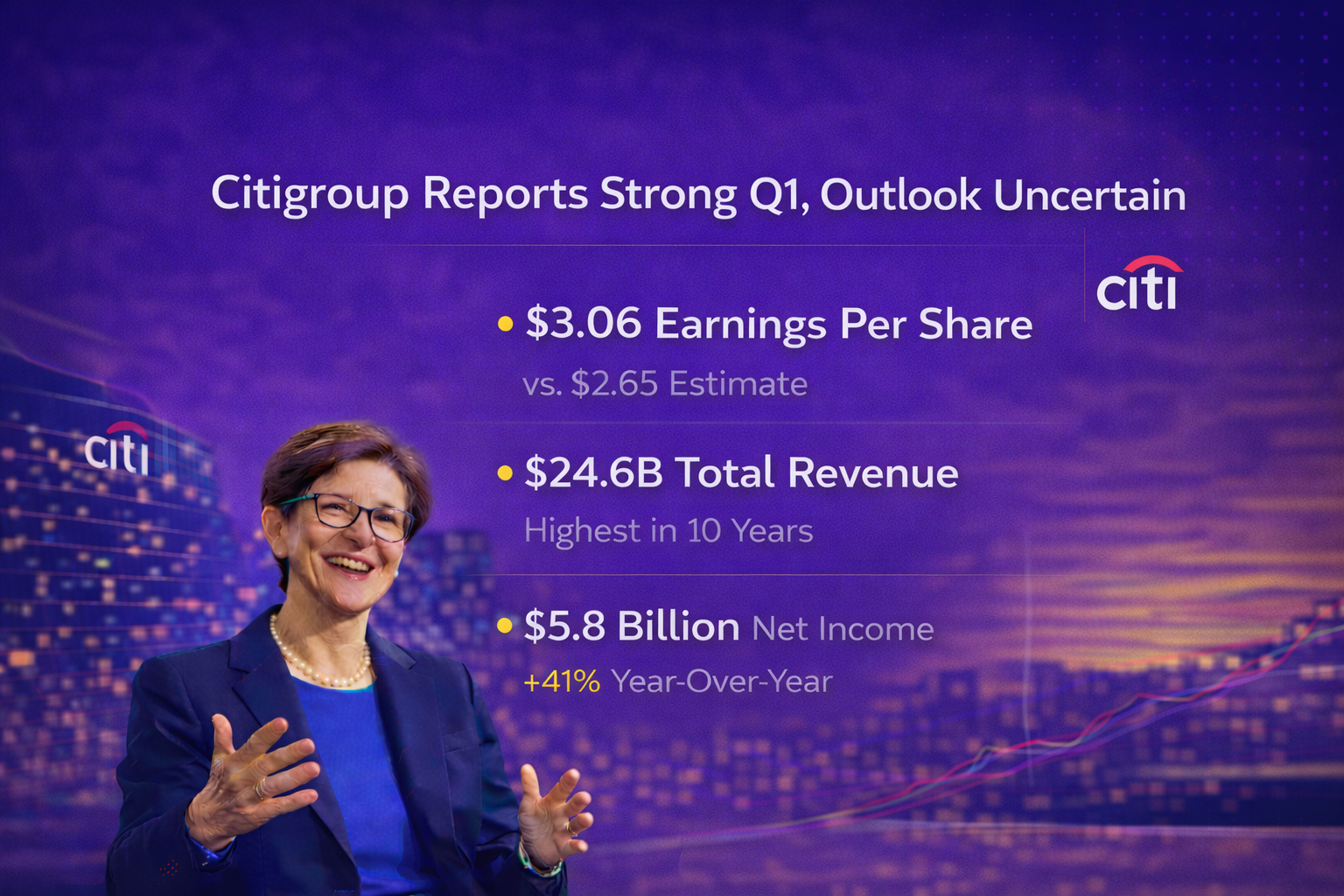
Citigroup reported better-than-expected results for the first quarter, beating both earnings and revenue estimates, and recording its highest quarterly revenue in ten years.
The bank posted earnings per share of $3.06, above the expected $2.65, while revenue came in at $24.63 billion, also higher than forecasts. Net income rose to $5.8 billion from $4.1 billion a year ago, with earnings per share increasing 56% year-over-year.
The strong performance was mainly driven by market volatility and steady dealmaking. Geopolitical tensions, including the U.S.-Israeli conflict involving Iran and disruptions in oil supply through the Strait of Hormuz, along with concerns about AI affecting software companies, led to large market movements. This increased trading activity as clients adjusted their portfolios.
Citi’s markets division was a key driver, with revenue rising 19% to $7.2 billion. Fixed income revenue increased 13% to $5.2 billion, while equities revenue jumped 39% to $2.1 billion, supported by strong performance in derivatives, prime services, and cash equities.
Investment banking also remained strong, with total banking revenue rising 15%. Equity underwriting increased 64% and M&A advisory rose 19%, though fixed income underwriting declined 6%. Overall industry investment banking revenue also saw solid growth during the quarter.
The bank’s return on tangible common equity (ROTCE) reached 13.1%, above its full-year target of 10%–11% and the highest since 2021. Net interest income rose 12%, while wealth management and retail banking revenue grew 11%, although returns in that segment were lower.
CEO Jane Fraser said the bank is on track to meet its targets and that about 90% of its restructuring work is complete. She also confirmed that Citi is focused on organic growth and not planning any acquisitions.
However, management warned that the economic outlook remains uncertain. The CFO noted that ongoing geopolitical tensions could affect dealmaking in the second half of the year.
Credit loss provisions were higher than expected at $2.81 billion, mainly due to losses in consumer cards and reserve build. Expenses rose 7%, driven by higher compensation and restructuring-related costs.
The bank also returned $6.3 billion to shareholders through share buybacks. Citigroup’s stock has been the best performer among major banks this year, rising over 100% in the past 12 months, although its valuation still remains lower than peers.
Overall, Citigroup delivered a strong quarter supported by trading and dealmaking, but global risks remain an important factor for its future performance.