

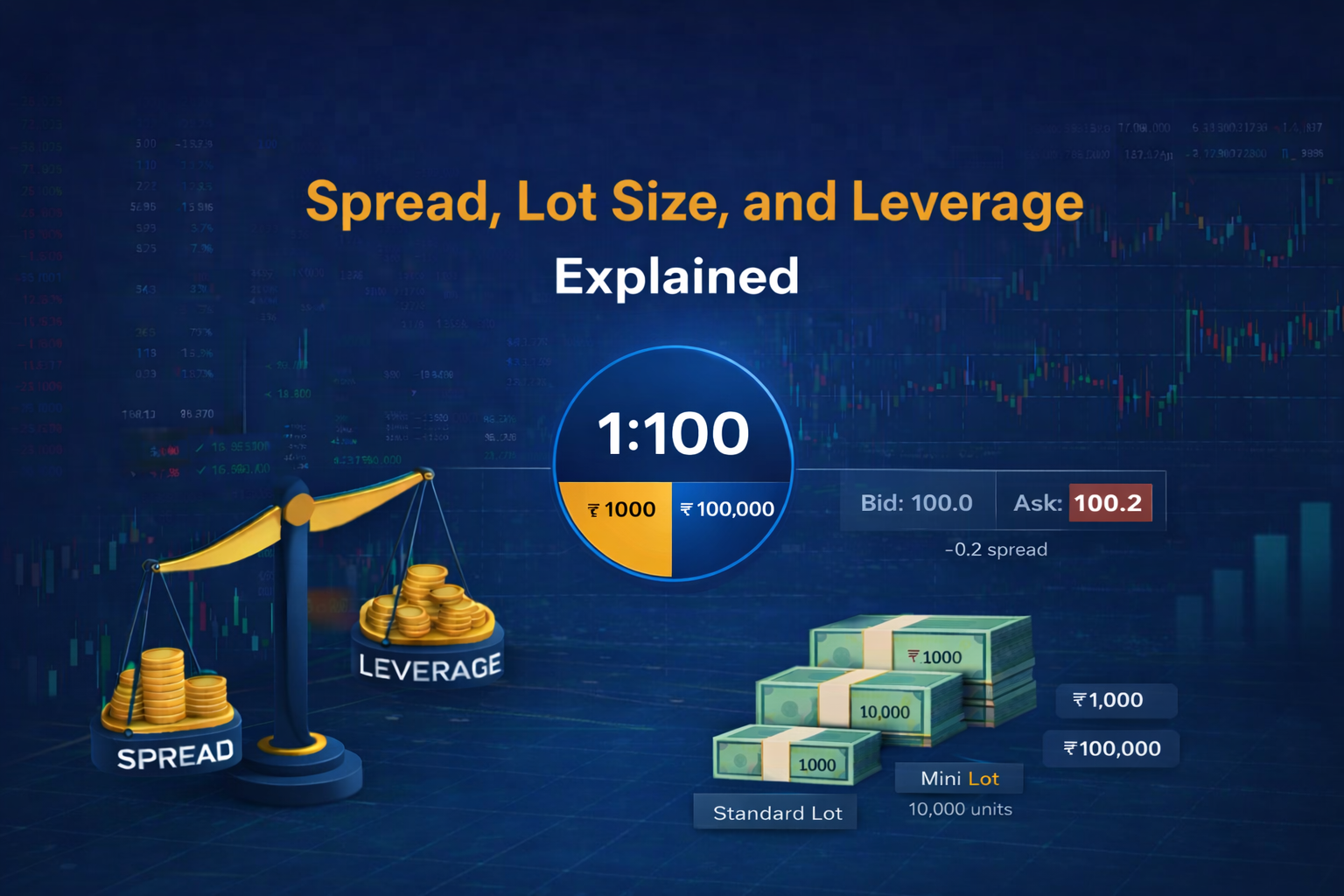
What is Spread, Lot Size, and Leverage in Trading?
Understanding spread, lot size, and leverage is essential for anyone entering the financial markets. These three concepts directly impact your trading cost, risk, and profit potential.
Spread
Spread is the difference between the Ask price (buy price) and the Bid price (sell price).
- Ask price → Price at which you can buy
- Bid price → Price at which you can sell
- The difference between them is called the spread
How Spread Works
When you enter a trade, immediately start with a small loss due to the spread:
- If you BUY: Enter at the Ask price (e.g., 100.2) and can only sell at the Bid price (100.0) → loss of 0.2
- If you SELL: Enter at the Bid price (100.0) and must buy back at the Ask price (100.2) → loss of 0.2
Why Spread Exists
The spread acts as a transaction cost and is one of the main ways brokers and liquidity providers earn revenue.
Types of Spread
- Fixed Spread: Remains constant regardless of market conditions
- Variable Spread: Changes based on liquidity and volatility
- Tight during high liquidity
- Wider during news or low activity
When Spread Changes
Spread is usually low during high-volume sessions like London and New York, where liquidity is strong. It becomes high during major news events (like NFP, CPI) and low-liquidity periods, as market volatility and uncertainty increase.
Traders should avoid entering trades during high spread conditions, especially during major news events and low-liquidity periods.
Lot Size
Lot size refers to the volume of your trade, or how much you are buying or selling.
Common Lot Sizes
- Standard lot = 100,000 units
- Mini lot = 10,000 units
- Micro lot = 1,000 units
Why Lot Size Matters
Lot size determines how much you gain or lose with each price movement in the market. A larger lot size increases profit potential but also raises risk, while a smaller lot size reduces risk and leads to smaller returns.
Leverage
Leverage allows you to control a larger position using a smaller amount of capital.
How Leverage Works
- Example: 1:100 leverage
- With ₹1,000, you can control ₹100,000 worth of assets
- The broker provides the remaining capital
Margin is the amount required to open a leveraged trade. It acts as a security deposit, not a cost.
Why Leverage is Powerful
Leverage is powerful because it allows traders to control larger positions with a smaller amount of capital, making trading more accessible. It also amplifies profit potential, as even small price movements can result in significant gains.
Risk of Leverage
- Losses are also magnified
- Small adverse moves can lead to significant losses
- Can result in margin calls if not managed properly
How These 3 Work Together in a Trade
- Spread → Cost of entering a trade
- Lot Size → Size of your position
- Leverage → Ability to trade larger than your capital
Basic Risk Rule
Always adjust your lot size so that you risk only 1–2% of your account per trade.
Final Takeaway
- Spread is the cost you pay to execute trades
- Lot size determines your risk and reward
- Leverage amplifies both profits and losses
- Margin is the capital required to open trades
- Managing all three effectively is key to consistent and safe trading