

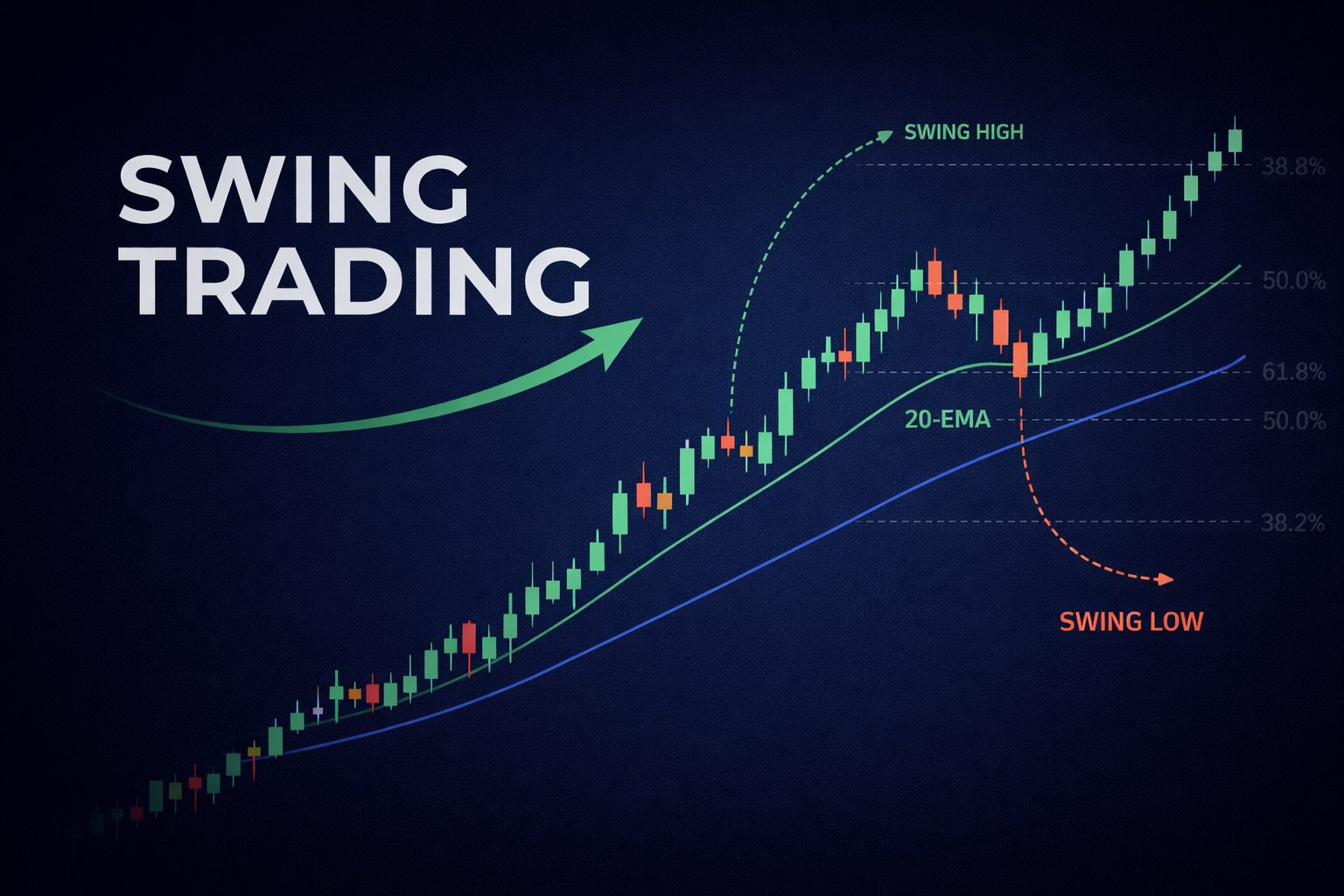
What Is Swing Trading?
Swing trading is a short- to medium-term trading strategy where traders aim to profit from price movements (“swings”) in financial markets over a period of a few days to several weeks.
Instead of holding assets for months or years like investors, swing traders focus on capturing temporary price fluctuations within a trend.
Key Takeaways
- Swing trading targets short-term price swings in stocks, forex, crypto, or commodities
- Trades are typically held from overnight to several weeks
- Relies heavily on technical analysis (charts, indicators)
- Aims to profit from trends, reversals, and breakouts
- Requires risk management and discipline
How Swing Trading Works
Swing traders attempt to capture a portion of a price move rather than the entire trend.
They typically:
- Identify a trend (uptrend or downtrend)
- Wait for a pullback or breakout
- Enter the trade
- Exit when the price reaches a target or shows reversal signals
The main goal is to buy near short-term lows and sell near highs, or vice versa in short-selling.
Common Swing Trading Strategies
1. Trend Following
Trend following means trading in the same direction as the overall market trend instead of going against it. In an uptrend, traders look to buy when the price pulls back to support levels, expecting the trend to continue higher. In a downtrend, traders look to sell during short-term rallies, as the price is likely to continue moving lower.
2. Breakout Trading
Breakout trading involves entering a trade when the price moves above a resistance level or below a support level. This indicates that the price may start a new strong move in that direction. Breakouts are usually more reliable when they happen with high volume, showing strong participation from traders.
3. Range Trading
Range trading is used when the market is moving sideways without a clear trend. In this strategy, traders buy near support (lower boundary) and sell near resistance (upper boundary). The idea is that the price will continue to move within the range until a breakout occurs.
4. Momentum Trading
Momentum trading focuses on stocks that are moving strongly in one direction with high speed. Traders enter when the momentum is strong and ride the move for short-term gains. They exit the trade when the momentum starts to slow down or show signs of reversal.
Indicators Used
Swing traders use technical tools to understand price movement, identify trends, and decide when to enter or exit a trade.
1. Moving Averages
Moving averages calculate the average price over a period of time and plot it on the chart, helping traders clearly see the direction of the trend. When price stays above the moving average, it usually indicates an uptrend, and when it stays below, it suggests a downtrend.
2. RSI (Relative Strength Index)
RSI measures how strong a price move is by comparing recent gains and losses, using a scale from 0 to 100, where values above 70 indicate the stock may be overbought (possible selling or profit-booking zone) and values below 30 suggest it may be oversold (potential buying opportunity).
3. MACD (Moving Average Convergence Divergence)
MACD compares two moving averages to show changes in momentum and trend direction, helping traders identify potential buy or sell signals. When the MACD line crosses above the signal line, it may indicate a buying opportunity, and the opposite suggests selling.
4. Fibonacci Retracement
Fibonacci retracement uses key percentage levels to identify how much a price has pulled back before continuing its trend, helping traders find potential entry points during corrections. These levels often act as support or resistance where price may reverse.
Advantages of Swing Trading
- Requires less screen time than day trading
- Captures larger price moves than intraday trading
- Works across multiple markets
Disadvantages of Swing Trading
- Exposure to overnight and weekend risk
- Requires strong technical analysis skills
- Market gaps can lead to unexpected losses
- Not suitable for completely passive investors
Who Should Use Swing Trading?
Swing trading is ideal for:
- Traders who cannot monitor markets all day
- Beginners looking for a balanced trading style
- Individuals comfortable with moderate risk
Swing trading sits between day trading and long-term investing, offering a balanced approach to capturing market opportunities. It requires a mix of technical analysis, patience, and risk management.
When done correctly, swing trading can generate consistent returns by taking advantage of natural market fluctuations.
Swing Trading Strategy Using S&P 500 (SPX)
Step 1: Choose the Index
Use the S&P 500 (SPX). It represents the top 500 US companies. You can also trade it through the SPY ETF.
Step 2: Identify the Trend
Check the daily chart. If price is above the 50-day moving average, it is an uptrend. Beginners should trade only in uptrends.
Step 3: Wait for a Pullback
Do not buy at the top. Wait for the price to retrace toward support. The 20 EMA or recent support levels work well.
Step 4: Confirm the Entry
Use simple indicators. RSI between 40 and 50 shows a healthy pullback. Look for a bullish candle near support. This confirms buyer strength.
Step 5: Enter the Trade
Enter after the confirmation candle closes. Avoid entering during the candle formation. Patience improves accuracy.
Step 6: Set Stop-Loss
Always define your risk. Place stop-loss below the recent swing low. This protects your capital.
Step 7: Set Target
Use a risk-reward ratio of 1:2. If you risk 50 points, aim for 100 points. You can also use resistance levels as targets.
Step 8: Manage the Trade
Move stop-loss to entry once the trade moves in your favour. This removes risk. You can trail the stop-loss using the 20 EMA.
Step 9: Exit the Trade
Exit when the target is reached. Exit early if weakness appears. Do not wait for perfect tops.
Swing trading is not about prediction. It is about reacting to price movement. Consistency and discipline lead to long-term success.